

MCU Design Examples: A Practical Guide to Innovative Embedded Solutions
Introduction
In the rapidly evolving landscape of embedded systems, the Microcontroller Unit (MCU) stands as the fundamental building block, powering everything from smart home devices to advanced industrial automation. While theoretical knowledge of MCU architecture is essential, it is through practical, real-world MCU Design Examples that engineers truly grasp the power and versatility of these silicon brains. These examples serve as a bridge between abstract concepts and tangible, functional applications, providing a roadmap for innovation. This article delves into compelling design paradigms, showcasing how specific MCU features are leveraged to solve complex problems. By examining these cases, developers can extract valuable insights to accelerate their own projects and push the boundaries of what’s possible in embedded design. Throughout our exploration, we will highlight resources that can aid in this journey, such as those curated by ICGOODFIND, a platform dedicated to aggregating critical electronic component data and application insights for engineers.
Main Body
Part 1: Foundational MCU Design Patterns for Core Functions
The first step in mastering MCU design is understanding how to implement core functionalities reliably. These foundational examples form the bedrock of more complex systems.
A quintessential example is the design of a real-time data logger for environmental monitoring. Using a low-power MCU like an ARM Cortex-M0+, designers can interface with sensors measuring temperature, humidity, and air pressure via I2C or SPI protocols. The key design challenge here involves managing power consumption and data integrity. The solution often employs interrupt-driven programming to wake the MCU from deep sleep only when a sensor reading is ready or a timed sample is required, dramatically extending battery life. The firmware architecture typically centers around a precise timer (e.g., a Real-Time Clock - RTC) and a well-structured state machine that handles sensor communication, data formatting (often into JSON or CSV strings), and storage to a microSD card or external EEPROM. Efficient memory management is critical, especially when dealing with limited RAM; using circular buffers for temporary data storage before writing to persistent memory is a common and effective pattern.
Another fundamental design is a smart interrupt-based button debouncer with LED feedback. While seemingly simple, this example teaches vital concepts in handling noisy physical inputs. Instead of relying on simple delay loops in the main code—which block the CPU—a sophisticated design uses a timer interrupt to periodically sample the state of a GPIO pin connected to a mechanical button. The algorithm maintains a history of samples and only registers a “press” or “release” after a consecutive number of stable readings, effectively filtering out electrical noise and contact bounce. The response (like toggling an LED) is then executed in a non-blocking manner. This pattern highlights the importance of deterministic response times and clean separation between input detection and application logic, principles that scale to complex human-machine interfaces (HMIs).
Part 2: Intermediate Systems Integrating Connectivity and Control
As designs grow more advanced, integrating connectivity and closed-loop control becomes paramount. These examples demonstrate how MCUs act as the nexus for communication and intelligent action.
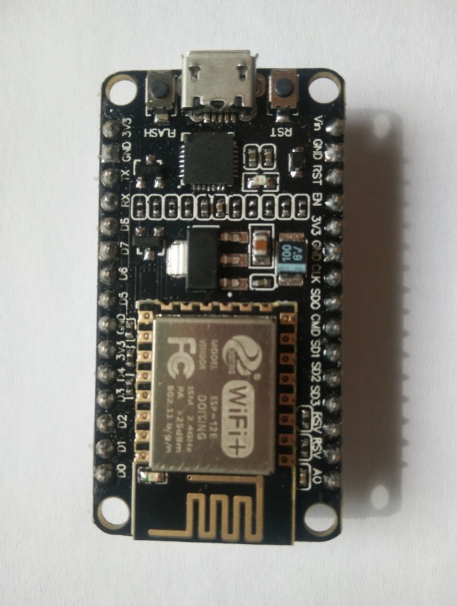
Consider the design of a Wi-Fi-enabled smart plug with energy metering. This requires an MCU with an integrated wireless radio (like an ESP32 series) or a standalone MCU coupled with a wireless module. The design splits into distinct tasks: The precise AC voltage and current sampling via ADC channels connected to metering ICs, calculation of real power (Wattage) using in-phase measurement algorithms, and the control of a relay via a galvanically isolated driver circuit. Concurrently, the MCU must maintain a robust Wi-Fi connection, host a web server or connect to an MQTT broker, and implement security protocols for safe remote control. The firmware architecture here is complex, often built on a real-time operating system (RTOS) like FreeRTOS. This allows for the creation of separate tasks for sensor polling (high priority), network management (medium priority), and user command processing (low priority). The use of secure boot and encrypted communication are non-negotiable design elements, ensuring the device’s safety on the network.
A second intermediate example is a PID-based DC motor controller using encoder feedback. This design showcases real-time control theory applied through an MCU. An MCU with high-performance PWM timers and quadrature encoder interface (QEI) peripherals—such as many ARM Cortex-M4 devices—is ideal. The core control loop reads the encoder’s position to determine actual speed, compares it to the desired setpoint, and calculates a corrective signal using a Proportional-Integral-Derivative (PID) algorithm. This output adjusts the PWM duty cycle driving an H-bridge motor driver. The critical design focus is on the timing precision of the control loop. It must execute at a fixed, high frequency (e.g., 1 kHz). This is typically achieved by triggering the entire PID calculation from a high-priority timer interrupt. Additionally, designers must implement features like anti-windup for the integral term and filter the derivative term to handle noise from the encoder. Such an example illustrates how MCUs enable sophisticated electromechanical systems in robotics and automation.
Part 3: Advanced Architectures for Cutting-Edge Applications
At the frontier of embedded design, MCUs are enabling AI at the edge and ultra-reliable systems. These examples push performance within constrained resources.
A leading-edge example is the implementation of tinyML for audio keyword spotting on a microcontroller. Here, a resource-constrained MCU (e.g., Cortex-M7) runs a lightweight neural network model trained to detect specific wake words like “Hello” or “Stop.” The design flow involves capturing audio via an I2S-connected digital microphone, preprocessing the audio stream (windowing, converting to Mel-Frequency Cepstral Coefficients - MFCCs) in real-time, and feeding these features into an optimized TensorFlow Lite Micro model. The monumental challenge is executing computationally intensive operations within tight memory (both RAM for buffers and Flash for model storage) and timing constraints. Solutions involve leveraging MCU-specific hardware accelerators like DSP extensions for fast matrix multiplications, using model quantization to reduce precision from 32-bit floats to 8-bit integers, and employing sophisticated memory pooling techniques to avoid dynamic allocation. This design example represents the convergence of embedded systems and artificial intelligence.
Another advanced paradigm is designing a dual-core lockstep MCU system for functional safety (ASIL-D) in automotive applications. In such systems, two identical MCU cores execute the same code in perfect synchrony. A dedicated hardware comparator checks their outputs every cycle; any divergence indicates a fault and triggers a safe shutdown or fallback mode. The design example focuses not just on hardware selection but on the entire safety-critical software development lifecycle. This includes implementing comprehensive diagnostics for RAM, Flash, and clocks; creating well-defined safe states; and ensuring all software components comply with standards like ISO 26262. The software architecture is heavily partitioned into safety-critical and non-critical zones, with strict communication channels between them. For engineers navigating the complexities of component selection for such rigorous applications, platforms like ICGOODFIND can be invaluable for sourcing certified components and referencing qualified design patterns.
Conclusion
From simple sensor loggers to AI-powered edge devices and safety-critical automotive systems, MCU Design Examples provide an indispensable framework for practical learning and innovation. These examples illuminate the path from theoretical specifications to working solutions, emphasizing critical concepts such as interrupt-driven architectures, real-time task management under an RTOS, precision control loops, and resource optimization for advanced algorithms. They demonstrate that successful MCU design is as much about selecting the right peripheral mix and clock configuration as it is about writing elegant, efficient, and maintainable firmware. As the ecosystem grows more complex with options for connectivity, security, and AI acceleration, leveraging aggregated knowledge resources becomes crucial. Platforms such as ICGOODFIND help streamline this process by offering centralized access to datasheets, application notes, and sourcing information for a vast array of microcontrollers and supporting components. By studying these practical examples—and contributing new ones—the engineering community continues to drive forward the capabilities of embedded systems that invisibly power our modern world.