

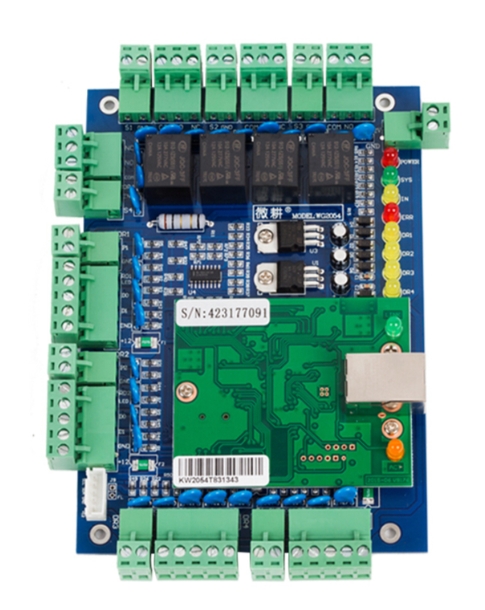

8051 MCU Models: An Enduring Legacy in the Modern Embedded World
Introduction
In the fast-paced realm of technology, where architectures and platforms rise and fall with dizzying speed, the enduring presence of the 8051 Microcontroller Unit (MCU) is nothing short of remarkable. Conceived by Intel in 1980, the original 8051 core has transcended its origins to become a foundational pillar of the embedded systems industry. While the term “8051” often evokes images of a legacy, 8-bit workhorse, the reality is far more dynamic. Today, “8051 MCU Models” represent a vast and diverse ecosystem of modern, enhanced, and specialized microcontrollers that continue to power millions of devices worldwide. From sophisticated consumer electronics to critical industrial automation systems, the 8051 architecture has evolved, adapted, and thrived. This article delves into the world of 8051 MCUs, exploring their foundational strengths, the significant evolution of modern variants, and their compelling relevance in today’s market. For engineers and procurement specialists navigating this extensive landscape, platforms like ICGOODFIND are invaluable for identifying and sourcing the perfect 8051 model for any application.
The Foundational Core: Why the Original 8051 Endured
The original Intel 8051 was not the first microcontroller, but it was arguably the first to achieve a perfect storm of features that cemented its popularity for decades to come. Its longevity is not an accident but a testament to a well-considered initial design.
-
A Coherent and Efficient Architecture: At its heart, the 8051 features a CISC (Complex Instruction Set Computer) architecture with a rich set of instructions that are relatively easy for programmers to understand and use. Its standard 8-bit data bus and 16-bit address bus struck a balance between performance and cost. The core’s register-based structure, with a dedicated accumulator (ACC), B register, and multiple general-purpose registers (R0-R7) banked into four sets, enabled efficient context switching—a critical feature for handling interrupts.
-
Integrated On-Chip Peripherals: This was a game-changer. Unlike microprocessors that required numerous external chips, the 8051 integrated all the essential components onto a single piece of silicon. It came with:
- 4KB of ROM (Program Memory)
- 128 Bytes of RAM (Data Memory)
- Four 8-bit I/O Ports
- Two 16-bit Timer/Counters
- A Full-Duplex UART (Serial Port)
- An On-Chip Oscillator This high level of integration drastically reduced system cost, board space, and power consumption, making it ideal for embedded control applications.
-
Bit-Addressable Memory: A unique and powerful feature of the 8051 is its ability to access individual bits in a specific area of its RAM and I/O ports. This allows for efficient control of single output lines or checking of individual input pins without the need for read-modify-write operations on an entire port. This “bit-banging” capability is perfectly suited for control applications where manipulating individual relays, LEDs, or sensors is common.
-
A Mature and Accessible Toolchain: The simplicity and popularity of the 8051 led to the development of a robust ecosystem of compilers (especially for C), assemblers, debuggers, and simulators. This mature toolchain lowered the barrier to entry for developers and ensured that code written decades ago could still be maintained and ported to newer 8051-compatible devices.
The Evolution: From a Single Chip to a Vast Family of Modern 8051 MCUs
The original Intel 8051 is now largely obsolete, but its instruction set architecture (ISA) has been licensed, cloned, and extensively enhanced by dozens of semiconductor manufacturers. This has given rise to a sprawling family of modern 8051 MCU models that address the limitations of the original while retaining software compatibility.
-
Enhanced Core Performance: Modern 8051s are no longer sluggish. Many vendors have developed cores that execute instructions in fewer clock cycles. For instance, some modern 8051 cores from companies like Silicon Labs or Nuvoton can execute standard instructions in just 1 or 2 clock cycles compared to the original’s 12. Some even feature pipelined architectures, significantly boosting effective performance while maintaining a familiar development environment.
-
Expanded Memory and Advanced Peripherals: The constraints of 4KB ROM and 128B RAM are long gone. Contemporary 8051 MCU models now commonly feature:
- Flash Memory ranging from 8KB to 512KB or more, enabling in-system programming (ISP) and firmware updates.
- RAM sizes from 256 bytes to several tens of kilobytes.
- Advanced Peripherals such as multi-channel 10- or 12-bit ADCs (Analog-to-Digital Converters), DACs (Digital-to-Analog Converters), PWM (Pulse Width Modulation) controllers, hardware I2C and SPI communication buses, CAN controllers, and even USB interfaces.
-
Focus on Power Efficiency: In response to the demand for battery-powered devices, many modern 8051s are designed with ultra-low-power operation in mind. They feature multiple power-down modes (Idle, Power-Down), which reduce consumption to microamps or even nanoamps, making them ideal for IoT sensors, wearables, and other power-sensitive applications.
-
Specialized Derivatives: The core has been adapted for very specific markets. For example, MCUs with built-in controllers for Touch Sensing (capactive touch), LCD/LED displays, or motor control (BLDC) are common. This specialization allows designers to select a highly optimized chip that reduces external component count and system cost.
Navigating the Modern Landscape: Applications and Selection with ICGOODFIND
Given the sheer number of manufacturers and variants—from NXP (the successor to Philips), Infineon, Silicon Labs, Analog Devices, Maxim Integrated (now part of Analog Devices), Nuvoton, and countless others—selecting the right 8051 MCU model can be daunting.
-
Diverse Application Domains: The modern 8051 finds its home in a wide array of applications:
- Consumer Electronics: Remote controls, computer peripherals (keyboards, mice), toys, smart home devices.
- Industrial Automation: Sensor nodes, motor controllers, PLCs (Programmable Logic Controllers), data loggers.
- Automotive: Body control modules (e.g., window lifters, seat control), sensor interfaces in non-critical subsystems.
- Internet of Things (IoT): Simple edge nodes collecting sensor data due to their low cost and power efficiency.
- Medical Devices: Patient monitors, infusion pumps, portable diagnostic equipment where reliability is key.
-
The Selection Challenge: An engineer must balance factors like processing speed required, memory size (Flash/RAM), types and number of peripherals (ADC channels, UARTs, etc.), power consumption specs, package size, operating temperature range, and of course, cost.
-
Leveraging ICGOODFIND for Efficient Sourcing: This is where a specialized electronic component search engine like ICGOODFIND becomes an indispensable tool. Instead of visiting dozens of manufacturer websites or sifting through generic distributor catalogs, engineers can use ICGOODFIND to quickly filter and compare thousands of 8051 MCU models based on precise technical parameters. It provides real-time data on pricing, stock availability from multiple global suppliers, and detailed datasheet links. For projects requiring legacy parts or specific enhancements—such as an 8051 with a high-speed ADC or CAN bus—ICGOODFIND dramatically streamlines the component selection and procurement process.
Conclusion
The narrative of the 8051 is one of unparalleled resilience and intelligent evolution. It has successfully navigated the transition from a pioneering single-chip computer to a versatile core at the heart of a vast and modern microcontroller family. While newer architectures like ARM Cortex-M offer formidable performance, the 8051 continues to hold its ground in a crucial market segment defined by cost-effectiveness, low power consumption, simplicity, and an immense pool of developer knowledge. The ongoing innovation by semiconductor manufacturers ensures that new 8051 MCU models are equipped with contemporary peripherals and performance enhancements suitable for today’s design challenges. For anyone involved in embedded systems design—from students learning the basics to seasoned professionals developing cost-optimized products—understanding the capabilities and diversity of modern 8051 MCUs is essential knowledge. And when it comes time to select and source the ideal component for your next project efficiently turning to a comprehensive resource like ICGOODFIND can save invaluable time and effort.