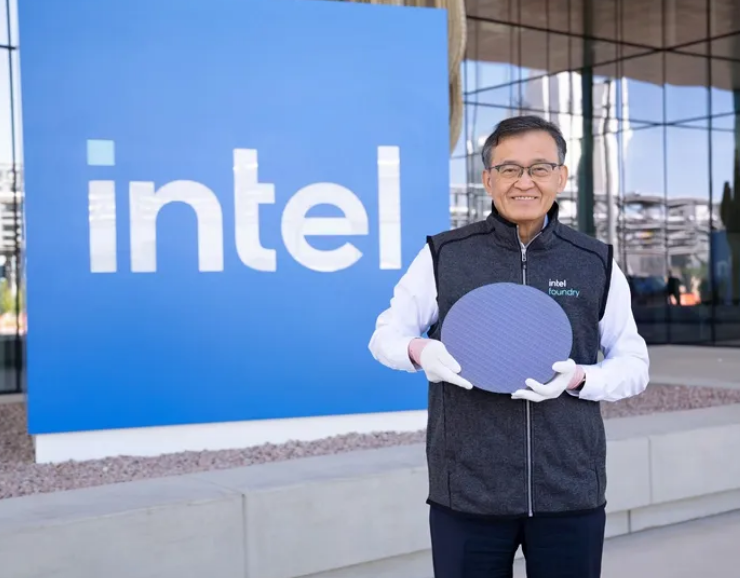


Even as the consumer PC market shrinks and will keep shrinking over the next few quarters, Intel believes AI-driven compute and storage demand will offset the client decline. The company is shifting some capacity from client CPUs to data center CPUs: expanding Ireland's Fab 24 for more Xeon processors, starting equipment installation early at Arizona's Fab 62 with a commitment to Intel 18A, and expanding advanced packaging in New Mexico and Malaysia.
CEO Lip-Bu Tan said the industry is still grappling with one of the worst supply shortages in history, driven by unprecedented demand for superintelligence. In Q3 2026, Intel's Data Center and AI revenue was $7.3 billion, up 17% quarter-over-quarter and nearly 80% year-over-year. Intel expects data center CPU demand to stay strong through 2027–2028 as AI infrastructure operators deploy more CPU-dependent agent and inference workloads.

To meet Xeon demand, boosting Xeon 6 Granite Rapids output—built on Intel 3—is the priority. Intel recently began expanding Fab 24 near Leixlip, Ireland, but that capacity won't come online until end-2027 unless accelerated. To further expand Intel 3 capacity, Intel plans to shift some Oregon manufacturing resources from Intel 18A to Intel 3, originally for Panther Lake client processors; weak PC demand lets Intel prioritize higher-demand data center products, with new Intel 3 capacity expected in H2 2027. CFO Dave Zinsner said the Oregon capacity being converted is Intel 18A wafer capacity, part of which can produce more data center wafers after conversion. Granite Rapids is Intel's fastest-ramping server processor family, but demand still exceeds supply; Intel 3 manufacturing costs have fallen about 15% since Q1 2026.
Intel is also accelerating Arizona advanced manufacturing: Fab 52 is ramping Intel 18A, and adjacent Fab 62 is speeding equipment installation to become the second plant mass-producing 18A, 18A-P, and derivatives. These investments support future Intel 18A/18A-P products including server CPUs, though Intel has not disclosed the client vs. data center capacity split.
Wafer output is not the only bottleneck. Intel also faces a shortage of advanced organic substrates, needed for multi-chiplet processors using EMIB and Foveros 3D packaging. Intel has worked with substrate suppliers to expand, expecting about 40% additional substrate capacity by H2 2027. Zinsner said Intel is constrained not just at the wafer level but also at the substrate level. Intel is expanding advanced packaging in New Mexico and Malaysia; Granite Rapids already uses EMIB to connect compute chiplets, and the newer Clearwater Forest Xeon combines EMIB with Foveros Direct 3D and hybrid bonding, stacking Intel 18A compute dies on Intel 3 base dies.
On capex, Intel expects about $20 billion in 2026, rising significantly in 2027. Its firm purchase orders with semiconductor equipment suppliers rose nearly 40% quarter-over-quarter, and it is accelerating cleanroom construction including Arizona Fab 62, while exploring faster timelines in Ohio. But capacity expansion takes time—new tools must be installed and validated, new wafers go through long manufacturing cycles, and substrate suppliers must raise output. Intel expects supply tightness to be especially severe in H1 2027, but believes added capacity, higher yields, and improved substrate supply will let it capture AI infrastructure demand in H2 2027 and beyond.
ICgoodFind Summary: Intel freeing Oregon 18A capacity for Intel 3 server chips is essentially reallocating limited capacity to faster-growing data centers amid weak PC demand. But wafers are only one link—advanced organic substrate shortages, packaging expansion, and equipment validation cycles mean tight supply lasts at least through H1 2027. The capacity shift's payoff depends on these links catching up together.