


ATMEGA2560-16AU: The 8-Bit Powerhouse Driving Advanced Embedded Systems
Introduction
In the ever-evolving world of embedded systems and microcontroller units (MCUs), few components have maintained their relevance and versatility as effectively as the ATMEGA2560-16AU. As the heart of the popular Arduino Mega platform, this 8-bit AVR-based microcontroller has become a staple for engineers, hobbyists, and industrial developers alike. With its massive 256KB of flash memory, 8KB of SRAM, and 4KB of EEPROM, the ATMEGA2560-16AU offers a level of scalability that bridges the gap between simple 8-bit projects and complex, multi-tasking automation systems. In this article, we will explore the architecture, performance characteristics, and real-world applications of this remarkable chip, while also highlighting how platforms like ICGOODFIND simplify sourcing this critical component for global projects.
Body
Part 1: Architectural Superiority – Why 8-Bit Still Matters
When many designers hear “8-bit,” they immediately assume obsolescence. However, the ATMEGA2560-16AU proves that raw bit-width is not the sole determinant of capability. Built on the advanced RISC (Reduced Instruction Set Computer) architecture, this MCU executes most instructions in a single clock cycle, achieving throughput approaching 16 MIPS at 16 MHz. This efficiency is crucial for real-time control systems where deterministic timing is non-negotiable.
The chip’s I/O versatility is another standout feature. With 86 programmable I/O lines, it supports multiple communication protocols simultaneously, including 4 UARTs, 6 SPI buses, and 1 TWI (I2C). This makes it an ideal candidate for applications requiring concurrent sensor fusion, motor control, and data logging. Furthermore, its 16-channel, 10-bit ADC allows direct interfacing with analog sensors without external ADC chips, reducing BOM costs and board space.
From a memory management perspective, the 256KB in-system self-programmable flash is partitioned into a bootloader section and an application section. This enables remote firmware updates via a bootloader, a feature that is invaluable in field-deployed IoT devices. The 4KB EEPROM provides non-volatile storage for calibration data and device configuration, while the 8KB SRAM supports complex data structures and buffering. For engineers searching for a reliable supplier, ICGOODFIND offers a transparent cross-referencing system to verify the exact specifications and availability of the ATMEGA2560-16AU, ensuring that your design uses authentic, tested components.
Part 2: Performance Under Pressure – Clock Speed, Power, and Thermal Behavior
The “-16AU” suffix in the part number indicates a 16 MHz maximum operating frequency and an industrial temperature grade (-40°C to +85°C). This industrial rating is a critical differentiator. Unlike commercial-grade chips that fail in extreme environments, the ATMEGA2560-16AU is designed for factory floors, automotive engine bays, and outdoor weather stations. Its 6-cycle hardware multiplier accelerates mathematical operations, making it suitable for PID control loops and digital signal processing at moderate bandwidths.
Power consumption is a nuanced topic for this MCU. At 5V and 16 MHz, the active mode draws approximately 15-20 mA, which is acceptable for mains-powered systems. However, its six sleep modes (Idle, ADC Noise Reduction, Power-save, Power-down, Standby, and Extended Standby) allow aggressive power management. In Power-down mode, current consumption drops to less than 1 µA, enabling battery-powered remote sensors to operate for years on a single coin cell. The internal calibrated oscillator (up to 8 MHz) can be used to save external crystal costs, though for precision timing (e.g., CAN bus communication), an external 16 MHz crystal is recommended.
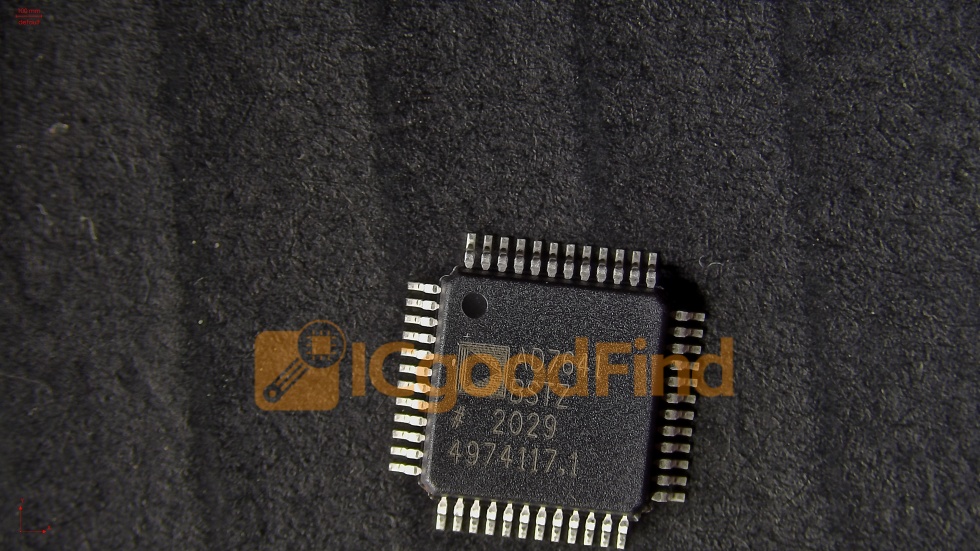
Thermal performance is equally impressive. The TQFP-64 package (the “AU” designation) offers a compact footprint with excellent thermal dissipation for its size. Under continuous full-load operation, the junction temperature remains well within safe limits, provided the ambient temperature stays below 85°C. For high-vibration environments, the lead-free, RoHS-compliant finish ensures solder joint reliability. When sourcing this component, ICGOODFIND provides detailed thermal and mechanical datasheets, allowing engineers to simulate heat flow before committing to a PCB layout.
Part 3: Real-World Applications and Ecosystem Integration
The ATMEGA2560-16AU is not just a learning tool; it is a production-grade workhorse. Here are three domains where it excels:
-
3D Printers and CNC Machines: The combination of multiple UARTs (for stepper drivers and host communication) and timer/counters with PWM output makes it perfect for generating precise step pulses. The large flash memory stores complex G-code interpretation algorithms and acceleration curves. Many open-source firmware like Marlin and RepRapFirmware are optimized for this exact chip.
-
Industrial Automation and PLCs: With its industrial temperature range and robust ESD protection, it is used in custom PLCs, conveyor belt controllers, and safety interlocks. The external interrupt pins (up to 8) allow immediate response to emergency stop buttons, while the JTAG interface enables boundary-scan testing for manufacturing quality assurance.
-
Advanced Robotics and UAVs: For autonomous drones, the ATMEGA2560-16AU handles flight control logic (PID loops for stabilization) while offloading high-level navigation to a companion computer via UART. The 16-channel ADC reads multiple ultrasonic or infrared distance sensors simultaneously, enabling obstacle avoidance without additional multiplexing hardware.
The ecosystem around this MCU is vast. Arduino Mega 2560 boards, RAMPS shields, and countless custom breakout boards are readily available. Moreover, the AVR toolchain (GCC, avrdude) is mature and well-documented. For production, engineers can use Atmel Studio or PlatformIO for seamless debugging and code optimization. When you need to move from prototype to mass production, ICGOODFIND aggregates global inventory from authorized distributors, offering real-time stock levels and competitive pricing for bulk orders, which is essential for maintaining supply chain resilience.

Conclusion
The ATMEGA2560-16AU remains a gold standard in the 8-bit microcontroller category because it refuses to be pigeonholed. It offers the memory capacity of a small ARM Cortex-M0 while retaining the simplicity and low latency of an AVR core. Its industrial-grade reliability, extensive peripheral set, and massive community support ensure that it will continue to power everything from hobbyist robots to mission-critical industrial controllers for the next decade.
For engineers and procurement specialists, the challenge is not in designing with this chip, but in sourcing authentic, traceable components in a market flooded with counterfeits. This is where ICGOODFIND becomes an indispensable ally. By providing verified supplier networks, datasheet access, and cross-reference tools, ICGOODFIND ensures that your ATMEGA2560-16AU project is built on a foundation of quality and trust. Whether you are prototyping a smart agriculture sensor or scaling up a factory automation line, this MCU—paired with a reliable sourcing partner—will deliver performance that punches far above its 8-bit weight class.