Since March 2026, a wave of price hikes has swept across the semiconductor industry. From FPGAs and CPUs to analog chips and passive components, ten major global semiconductor companies have issued price increase notices covering all core product categories. The following is a brand-by-brand summary, sorted by notice date, to help downstream customers navigate the current cost pressures.
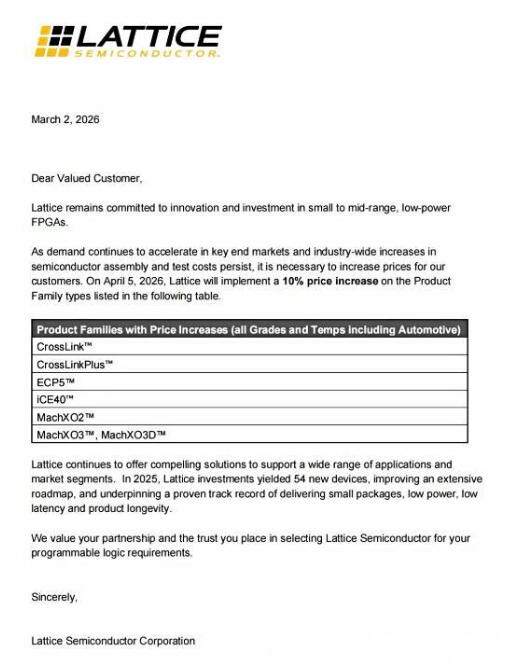
Lattice Semiconductor (FPGA)
Issued notice on March 2, citing accelerating demand in key end markets and rising industry-wide assembly and testing costs. Effective April 5, the company will raise prices by 10% on multiple FPGA families, including CrossLink, CrossLinkPlus, ECP5, ICE40, and MachXO2—across all grades, temperatures, and automotive variants. Lattice focuses on small-footprint, low-power FPGAs and invested in 54 new devices in 2025 to strengthen its roadmap.
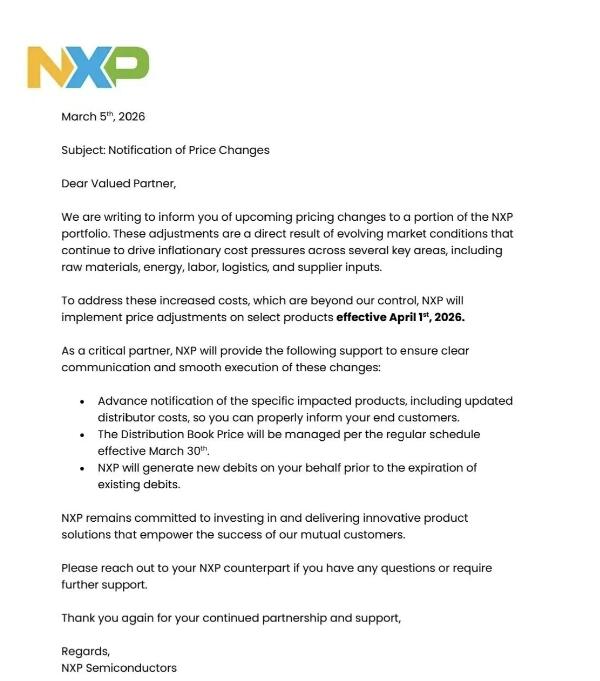
NXP (Automotive Chip Leader)
Issued formal notice on March 13 (following earlier speculation). Rising costs of raw materials, energy, labor, and logistics prompted the adjustment. Effective April 1, select products will see price increases. Updated distributor pricing and catalog rates take effect March 30, with affected part numbers to be communicated through sales channels.
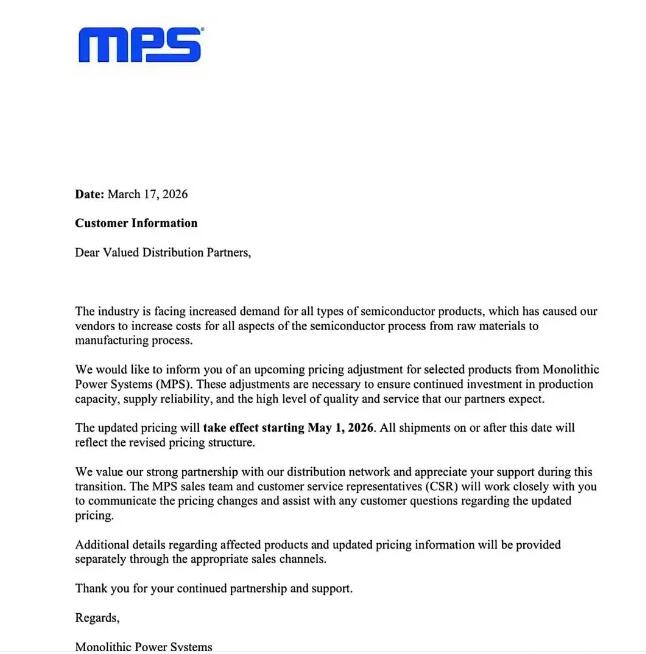
MPS (Analog IC)
On March 17, MPS notified distribution partners of price adjustments on select product lines due to rising costs across the full supply chain—from raw materials to manufacturing. The new pricing takes effect May 1, applying to all orders shipped on or after that date. MPS is a Nasdaq-listed leader in high-performance analog and mixed-signal ICs, serving automotive, cloud computing, consumer, and industrial markets.
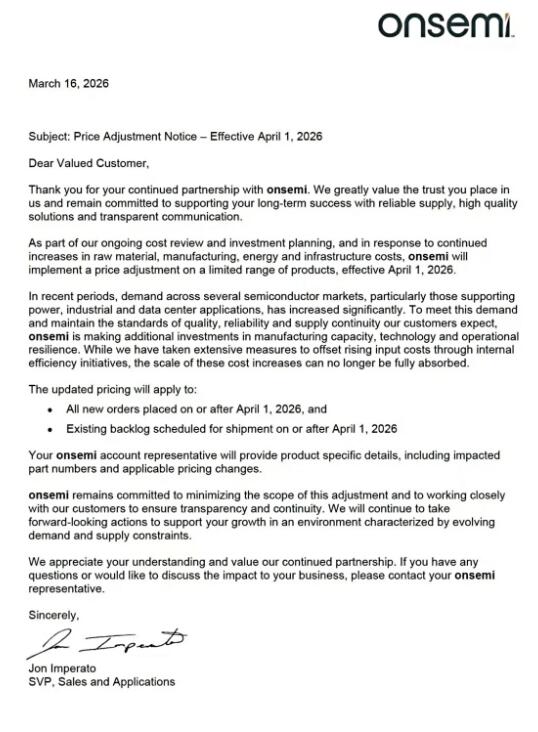
onsemi
Issued notice on March 17, citing sustained cost increases in raw materials, manufacturing, energy, and infrastructure. Effective April 1, price adjustments apply to new orders placed on or after that date, as well as existing backlog shipping after April 1. onsemi noted surging demand in power, industrial, and data center segments, and said internal efficiency gains could not fully absorb cost pressures.
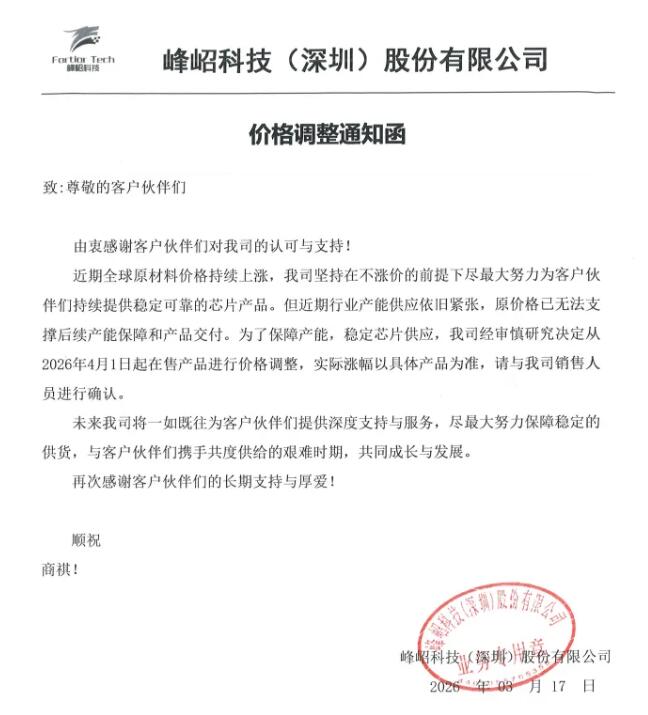
Fortior Technology (Chinese MCU)
Issued notice in mid-to-late March. Tight industry capacity and supply constraints made existing pricing unsustainable. Effective April 1, the company will adjust prices across its in-stock product lines. Fortior specializes in BLDC motor driver control chips, with MCUs accounting for 64.06% of 2024 revenue.
Diodes
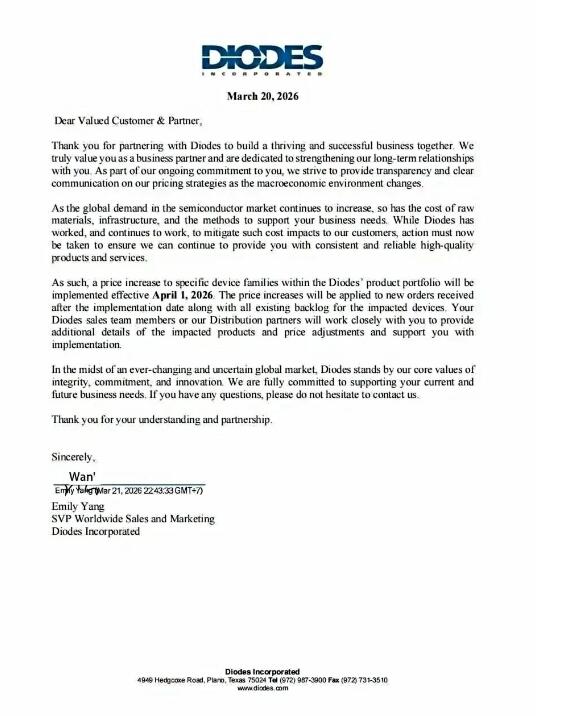
On March 20, Diodes announced price increases on specific device families, effective April 1. The adjustment applies to new orders received on or after that date, as well as existing backlog for affected parts. Rising global semiconductor demand and increased raw material and infrastructure costs drove the decision.
Intel (CPU)
On March 20, Intel notified key customers of a 10% price increase across its PC CPU lineup, covering entry-level to high-end processors, effective late March. The move reflects growing CPU workloads driven by AI inference, combined with capacity constraints and pressure to prioritize higher-margin data center business. With Intel holding roughly 70% of the PC CPU market, the increase is expected to push notebook retail prices higher—potentially up to 40% when combined with memory price hikes.
STMicroelectronics
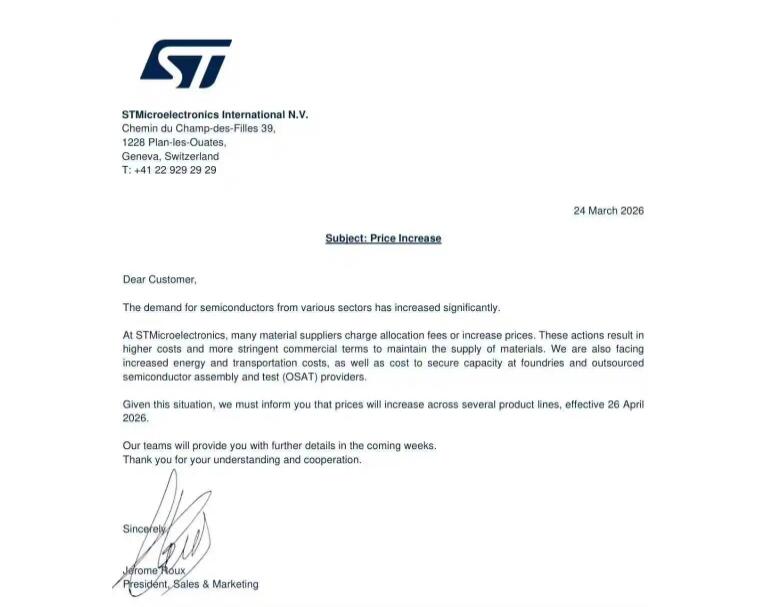
On March 24, ST formally announced price increases across multiple product lines, effective April 26. Strong global semiconductor demand, coupled with supplier allocation fees, rising energy and transportation costs, and higher fab and OSAT capacity expenses, left the company with no choice but to adjust pricing. ST said detailed information would follow in the coming weeks.
Murata (Passive Components Leader)
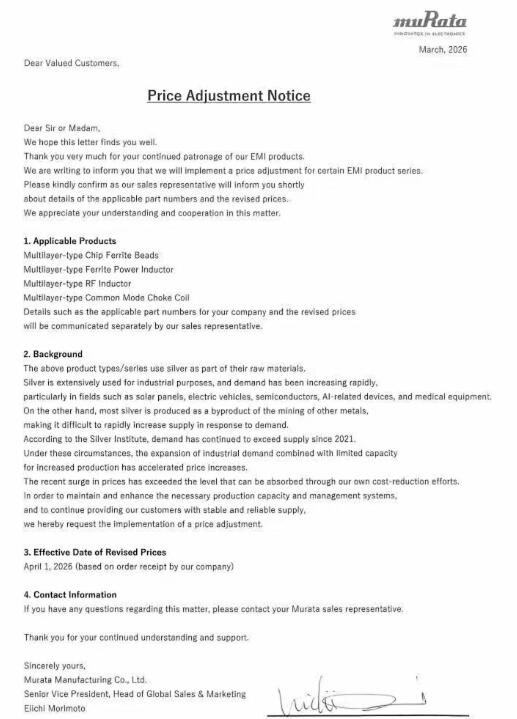
In late March, Murata announced price increases of 15% to 35% on four core product categories—including AI server and high-end automotive MLCCs, ferrite beads, power inductors, RF inductors, and common mode chokes. The new pricing takes effect April 1. This marks Murata’s first large-scale price adjustment in three years, driven by rising silver prices, strong industrial demand, tight supply, and currency fluctuations. Murata holds over 40% of the global MLCC market and 70% in AI servers. High-end MLCC orders currently exceed production capacity by a factor of two.
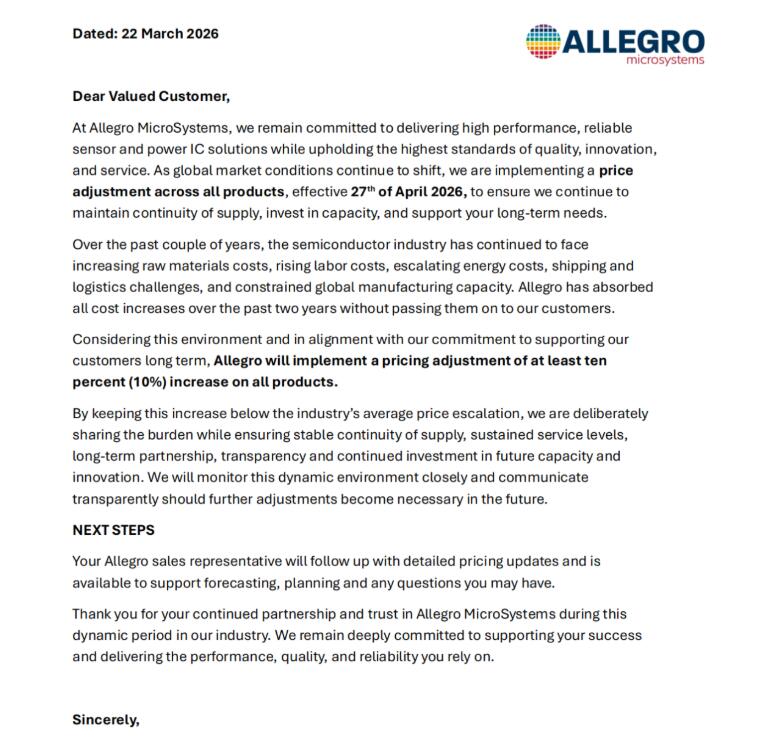
Allegro (Magnetic Sensor Leader)
In late March, Allegro announced a minimum 10% price increase across its entire product line, effective April 27. Rising costs of raw materials, labor, energy, logistics, and global manufacturing capacity constraints prompted the move. Allegro said it had absorbed costs previously but now needs to share the burden with customers to ensure stable supply and service.
ICgoodFind : From March to May, ten major semiconductor companies have rolled out price increases across multiple product categories. Tight capacity and rising costs are the common drivers. Downstream customers should plan ahead to manage the impact.