TSMC's strategic expansion in the US faces severe profitability challenges amid the push for semiconductor supply chain localization. Recent data from SemiAnalysis, highlighted by analyst Jukan, reveals that the 5nm chips produced at TSMC's US fab operate at a mere 8% gross margin. This marks a staggering 56-percentage-point drop from the 62% margin achieved for the same technology in Taiwan, representing a near 87% decline. Soaring labor costs and wafer depreciation expenses are the core drivers.
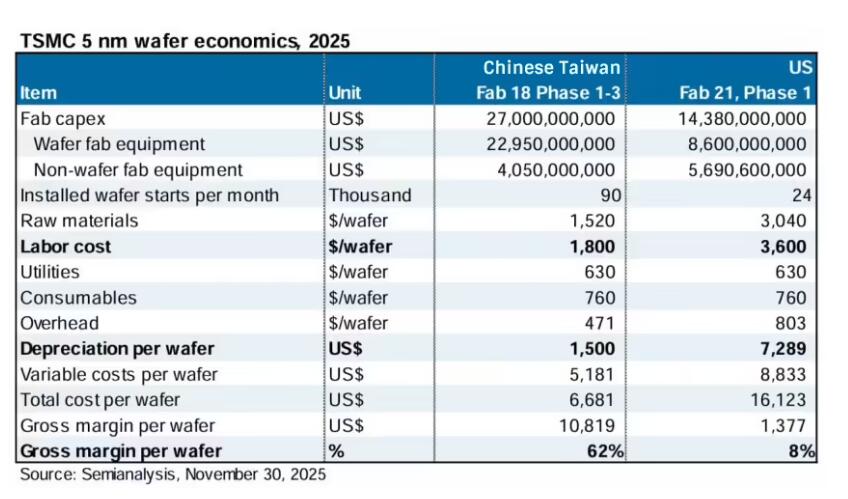
The disparity in depreciation cost is a critical pain point. The output of the US wafer fab per process node is only about one-quarter of its Taiwan counterpart's, leading to per-wafer depreciation costs roughly four times higher. Combined with elevated construction and ongoing operational expenses, the US factory requires exceptionally high capacity utilization and product pricing to offset this heavy "fixed cost burden." Although TSMC's first Arizona fab is now in production with its capacity booked through next year, its limited short-term scale continues to hinder cost dilution.
Labor costs and efficiency differences further intensify the pressure. The average annual salary for US semiconductor engineers is approximately $97,000, significantly higher than in Taiwan. TSMC must either hire costly local talent or bear additional expenses for dispatched personnel. Founder Morris Chang once highlighted the cultural gap: equipment failure at a US plant at midnight might wait until morning for repair, while engineers in Taiwan would respond immediately. This efficiency gap indirectly elevates operational costs and has contributed to recent sharp quarterly profit declines at the Arizona site, undermining the sustainability of overseas manufacturing.
Despite the profit pressure, TSMC remains committed to its long-term US strategy. The company plans to increase its total related long-term investment to up to $300 billion, covering the Arizona fab network, advanced packaging, and R&D facilities. A second fab is expected to begin 3nm production in 2027, and preliminary engineering for a third 2nm fab is underway.
ICgoodFind Perspective: Overseas expansion requires a careful balance between strategic goals and cost realities. We will continue to monitor industry shifts to help the supply chain navigate this evolving landscape.