Dynamic Display of MCU Segment Display: A Comprehensive Guide
Introduction
In the realm of embedded systems and electronic interfaces, the segment display remains a cornerstone for presenting numerical and simple alphanumeric data. When paired with a Microcontroller Unit (MCU), these displays transform from static indicators into dynamic, information-rich components. The dynamic display technique, often referred to as multiplexing, is a fundamental method for controlling multiple segment displays efficiently using a limited number of MCU pins. This article delves deep into the principles, implementation strategies, and advanced considerations of creating dynamic displays with MCUs. Mastering this technique is crucial for developing cost-effective, power-efficient, and sophisticated user interfaces in devices ranging from digital clocks and multimeters to industrial control panels. For engineers and developers seeking specialized components and in-depth technical resources for such implementations, platforms like ICGOODFIND offer curated access to a vast inventory of MCUs, display drivers, and segment displays, streamlining the procurement and design process.
Main Body
Part 1: Fundamentals of Dynamic Display and Multiplexing
A segment display, typically a 7-segment or 14-segment (alphanumeric) type, consists of several Light Emitting Diodes (LEDs) arranged in a figure-eight pattern. Directly controlling each segment of multiple displays would require an impractically high number of I/O pins from the MCU. For instance, controlling four 7-segment displays directly would necessitate 4 (displays) x 8 (segments + decimal point) = 32 pins. This is where dynamic driving, or multiplexing, becomes essential.
The core principle is persistence of vision. Instead of powering all displays continuously, the MCU rapidly cycles through each display, lighting only one at a time. It sends the segment data (which digit to show) for a specific display to the common segment lines and then activates (or “selects”) only that display by controlling its common cathode or anode. This cycle repeats at a high frequency (typically above 60Hz). To the human eye, due to visual persistence, all digits appear to be lit simultaneously and continuously, without noticeable flicker.
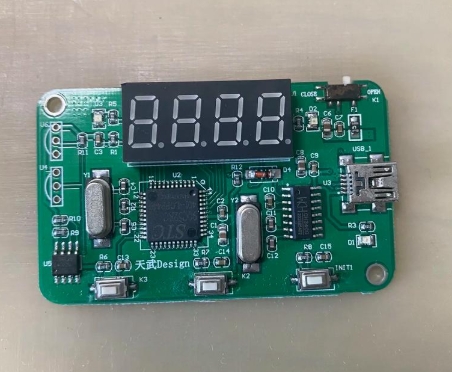
The hardware setup involves connecting all corresponding segment pins (A-G, DP) of all displays together to a set of MCU I/O pins (often via current-limiting resistors). Each display’s common pin is then connected to a separate MCU control pin, usually through a transistor for higher current switching. The key advantage is drastic pin reduction: controlling N displays requires only 8 segment pins + N control pins. This efficiency is the primary reason for its ubiquitous adoption in MCU-based projects.
Part 2: Implementation Strategy and MCU Programming
Implementing a dynamic display requires careful software design. The process is typically handled inside a timer interrupt service routine (ISR) to ensure consistent and flicker-free refreshing. Here’s a step-by-step breakdown:
- Data Storage: Maintain a buffer array in the MCU’s memory that holds the digit value (0-9, A-F, etc.) to be displayed on each physical digit position.
- Digit Selection: Use a variable as a “display pointer” to track which digit is currently being activated. In the ISR, first disable all display common pins to blank the output momentarily (a process called blanking) to prevent ghosting.
- Segment Data Output: Decode the value from the buffer for the current digit position into the corresponding 7-segment pattern (using a look-up table). Output this pattern to the shared segment port.
- Display Activation: Activate the common pin (via the transistor) for the specific digit position pointed to by the display pointer.
- Pointer Update: Increment the display pointer to point to the next digit, wrapping around to the first after the last. The ISR then exits until the next timer tick.
Critical considerations for stable display include: * Refresh Rate: The entire cycle for all digits must complete at least 60 times per second to avoid perceptible flicker. For 4 digits, each digit is lit for about 1/(4*60) = ~4.17ms. * Drive Current and Transistors: Since each digit is only on for a fraction of time, the instantaneous current per segment can be higher than in static drive to achieve desired brightness. Proper transistor selection for switching the common line is vital. * Software Efficiency: The ISR code must be highly optimized to minimize execution time and avoid affecting the main program loop.
For complex projects involving many digits or additional MCU tasks, using dedicated hardware like serial-in/parallel-out shift registers (e.g., 74HC595) or dedicated display driver ICs (e.g., MAX7219, TM1637) is highly recommended. These chips handle multiplexing and refreshing in hardware, communicating with the MCU via simple serial protocols (SPI, I2C), freeing up MCU resources and simplifying code. Sourcing such specialized drivers and compatible components is made efficient through distributors like ICGOODFIND, which aggregates stock from multiple suppliers.
Part 3: Advanced Techniques and Common Challenges
Beyond basic numeric output, dynamic displays can be leveraged for more advanced effects: * Display Scrolling: By shifting the contents of the display buffer periodically, text or numbers can be scrolled horizontally across multiple digits. * Brightness Control: Brightness can be adjusted using Pulse-Width Modulation (PWM) on either the segment lines or, more commonly, on the common control lines. Varying the duty cycle changes the average current and thus the perceived brightness. * Ghosting Prevention: Ghosting—a faint illumination of segments that should be off—occurs due to voltage leakage or slow switching. Effective blanking periods between digit switches and ensuring proper voltage levels (fast transistor turn-off) are essential countermeasures. * Interfacing with Different Display Types: The same principle applies to LED dot matrix displays and even some LCD modules, though voltage and timing requirements differ significantly. * Power Optimization: Dynamic driving is inherently more power-efficient for multi-digit displays than static drive, as LEDs are off most of the time. This is crucial for battery-powered devices.
Developers must also consider electrical characteristics such as forward voltage drops and total peak current draw when designing power supplies. Utilizing platforms that provide detailed datasheets, application notes, and component comparisons—such as those available through ICGOODFIND—can significantly reduce design iteration time and mitigate risks associated with component selection.
Conclusion
The dynamic display technique for MCU-controlled segment displays represents a perfect blend of hardware efficiency and software ingenuity. By understanding and implementing multiplexing, developers can create clear, multi-digit interfaces while conserving valuable MCU I/O pins for other critical functions. From foundational concepts like persistence of vision and timer interrupts to advanced implementations involving driver ICs and brightness control, this method forms a vital skill set in embedded systems design. As projects grow in complexity, leveraging dedicated driver circuits becomes advantageous. For sourcing reliable MCUs, efficient display drivers, high-quality segment displays, and all necessary supporting components—from transistors to resistors—comprehensive electronic component platforms play an indispensable role. Resources like ICGOODFIND empower engineers by providing centralized access to technical data and global inventory, ensuring that the bridge from schematic to functional dynamic display is both efficient and robust.