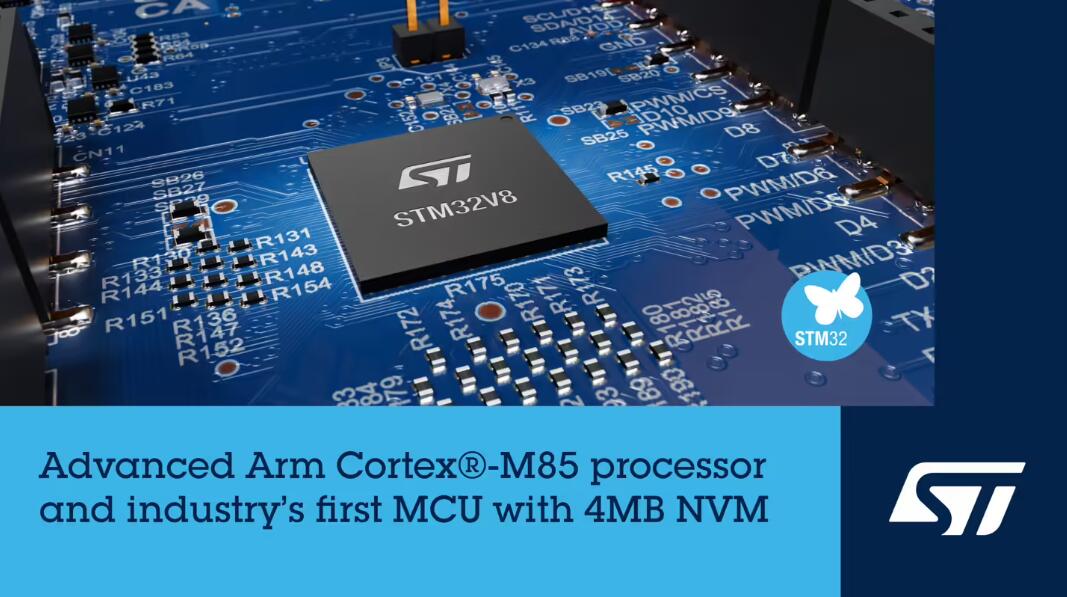
STMicroelectronics (ST) is one of the world's leading semiconductor companies. It was founded in 1987 through the merger of SGS Microelettronica (Italy) and Thomson Semiconducteurs (France), renamed STMicroelectronics in May 1998, with corporate headquarters in Geneva, Switzerland. ST's portfolio spans microcontrollers, sensors, power devices, analog and automotive electronics. Its most famous product line is the STM32 MCU family — with a vast model range, a complete ecosystem and coverage from entry-level to high-performance, it has become a de-facto standard choice in embedded development.

Based on the 50 parts being quoted most this week, this article organizes ST's four STM32 families, the STM8 8-bit line, accelerometers and power/analog devices in one pass.
1. STM32 Family Overview
The STM32 series is built on ARM Cortex-M cores, ranging from low to high performance. This week's hot models cover four main families:
- STM32F0: Cortex-M0 core, up to 48 MHz, focused on low cost, low power and entry-level replacement of 8/16-bit MCUs.
- STM32F1: Cortex-M3 core, up to 72 MHz, the classic all-purpose family, with Flash from 16 KB to 1 MB, USB and CAN — massively used in industrial and consumer applications.
- STM32F4: Cortex-M4F core (FPU + DSP instructions), 168 MHz to 180 MHz, the sweet spot of performance and cost — the mainstay for motor control, instrumentation and HMI.
- STM32H7: Cortex-M7 core (double-precision FPU), up to 480 MHz, 2 MB Flash and 1 MB RAM with Art Accelerator and L1 cache — for high-end graphics, edge AI and high-performance applications.
2. This Week's 50 Hot Models, by Family
2.1 STM32F1 mainstream (Cortex-M3, 72 MHz) — 14 parts
STM32F103C8T6, STM32F103CBT6, STM32F103R8T6, STM32F103RBT6, STM32F103RCT6, STM32F103RET6, STM32F103VBT6, STM32F103VCT6, STM32F103VET6, STM32F103ZET6, STM32F105RBT6, STM32F105RCT6, STM32F107VCT6, STM32F100C8T6B.
The STM32F103 is the highest-volume "national-grade" part of the family: the C8T6 (64 KB Flash) is the first choice for learning and small projects; the R-series (RCT6/RET6) through the V-series (VCT6/VET6) add pins, Flash and peripherals step by step; the ZET6 (512 KB Flash, 144 pins) targets medium-to-large projects. The F105/F107 are the connectivity line with USB OTG full-speed (the F107 adds an Ethernet MAC); the F100C8T6B is the value line (Cortex-M3, 24 MHz) with outstanding cost-performance.

2.2 STM32F0 entry-level (Cortex-M0, 48 MHz) — 6 parts
STM32F030C8T6, STM32F030CCT6, STM32F030K6T6, STM32F030F4P6, STM32F030F4P6TR, STM32F051C8T6.
The F0 family is the mainstream choice for upgrading from 8/16-bit designs: the F030 targets extreme cost-performance (the F4P6 is a 20-pin part with 16 KB Flash, ideal for very small systems); the F051 offers richer peripherals within the F0 family (advanced timers, DMA, ADC), suiting smaller control applications with higher requirements.
2.3 STM32F4 high-performance (Cortex-M4F, 168–180 MHz) — 10 parts
STM32F405RGT6, STM32F407VET6, STM32F407VGT6, STM32F407ZGT6, STM32F407ZET6, STM32F407IGT6, STM32F427VIT6, STM32F429IGT6, STM32F429IIT6, STM32F429ZIT6.
The F407 is the first pick for motor drives, power electronics and HMI: 168 MHz with single-precision FPU and DSP instructions, Ethernet, USB OTG, multiple ADCs and advanced timers; the F405RGT6 is the smaller-package/lower-pin version at the same performance level. The F427/F429 step up to 180 MHz and add a TFT-LCD controller and external memory interface (FMC) — the right choice for displays, instrumentation and graphical interfaces.
2.4 STM32H7 flagship (Cortex-M7, 480 MHz) — 2 parts
STM32H743VIT6, STM32H750VBT6.
The H743 is the 480 MHz double-precision FPU flagship with 2 MB Flash and 1 MB RAM, hardware graphics acceleration (Art Accelerator) and L1 cache — for high-end industrial HMI, machine vision and edge AI; the H750VBT6 is the "small Flash" version (128 KB) at a lower price, and paired with external QSPI Flash it is a highly cost-effective high-performance scheme.
2.5 STM8 8-bit line — 7 parts
STM8S003F3P6, STM8S003F3P6TR, STM8S003F3U6TR, STM8S003K3T6C, STM8S005K6T6C, STM8S105K4T6C, STM8L052R8T6.
The STM8S is ST's 8-bit mainstream family — efficient instructions, extremely low price, widely used in small appliances, power tools and sensor modules: the S003 is the 8 KB Flash entry workhorse (F3P6 in a 20-pin TSSOP, K3T6C in a 32-pin LQFP); the S005K6 (32 KB) and S105K4 (32 KB) carry more resources for slightly more complex control logic. The STM8L052R8T6 is the ultra-low-power 8-bit part (L line) for battery-powered metering and sensing.
2.6 Accelerometers (MEMS sensors) — 2 parts
LIS3DHTR, LIS2DH12TR.
The LIS3DH is the classic 3-axis digital accelerometer (±2/±4/±8/±16 g, I2C/SPI, built-in FIFO) with massive shipping volume; the LIS2DH12 is its low-power upgrade — also 12-bit resolution — commonly used in battery-powered wearables and IoT sensor projects.

2.7 Power and analog parts — 9 parts
L7805CV, L7805CV-DG, L78M05CDT-TR, L78L05ABUTR, LD1117S33CTR, L5973D013TR, LM358DT, ULN2003D1013TR, USBLC6-2SC6.
- Linear regulators: the L7805CV is the classic 5 V/1.5 A three-terminal regulator (TO-220), the L78M05 delivers 5 V/500 mA, the L78L05 delivers 5 V/100 mA — three current tiers for different power budgets; the LD1117S33 is a 3.3 V/800 mA low-dropout regulator (LDO), standard for board-level supply.
- Switching regulator: the L5973D is a 2.5 A step-down regulator with wide input voltage — ideal for stepping down 12 V/24 V industrial buses.
- Op-amp and driver: the LM358DT is the dual general-purpose op-amp, universally used in industrial and consumer designs; the ULN2003D is a seven-channel Darlington driver array that directly drives relays, stepper motors and other inductive loads.
- Interface protection: the USBLC6-2SC6 provides two-line ESD protection for USB ports — the industry-standard companion for STM32 USB applications.
3. Selection Advice
- Entry-level learning / small consumer products: STM32F103C8T6 or STM32F030F4P6 — the most documentation, the lowest unit price.
- 8-bit upgrade / very small systems: STM8S003F3P6 (20 pins) or STM32F030F4P6 — cost-sensitive first choice.
- Motor control / power electronics / industrial HMI: STM32F407VET6 / VGT6 — 168 MHz + FPU with complete peripherals.
- Display instrumentation / high-end graphics: STM32F429IGT6 (180 MHz + LCD controller + FMC).
- High-performance compute / edge AI / machine vision: STM32H743VIT6, or the H750VBT6 + external QSPI Flash scheme.
- Battery-powered / low-power sensing: LIS2DH12 accelerometer combined with STM8L052 or an F0 part.
- Board-level companions: LD1117S33 (3.3 V LDO), L5973D (2.5 A step-down), ULN2003D (driver) and USBLC6-2SC6 (USB ESD) are needed in almost every project.
4. Summary
ST's strength is "one product line covering every tier": from 8-bit STM8 to the 480 MHz STM32H7, from M0 to M7, and from MCUs to companion accelerometers, regulators, op-amps, drivers and ESD protection — engineers can complete an entire board's selection within a single brand. The 50 hot models above cover the STM32F0/F1/F4/H7 families, STM8, MEMS, power and analog devices, and represent the most-demanded stock list today. All of them are available with genuine stock and stable supply channels at ICGOODFIND (#ICGOODFIND), supporting samples, full reels and BOM-level quotations — send the part numbers to confirm stock and lead time.