Intel has achieved a significant milestone by installing the world's first production-ready High-NA Extreme Ultraviolet (EUV) lithography system at its advanced manufacturing facility. The ASML Twinscan EXE:5200B machine, featuring a 0.55 numerical aperture, has passed initial acceptance tests. It will be dedicated to developing Intel's Intel 14A (1.4nm) process node, marking the transition of this cutting-edge technology from research to commercial chip production.
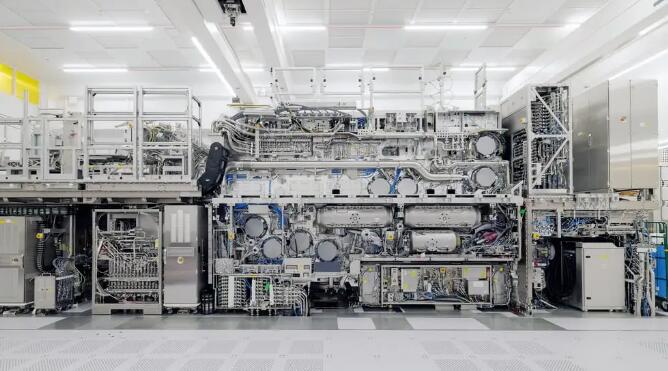
The High-NA system represents a major technological leap. It offers a resolution of 8nm, significantly better than the 13nm achievable by current Low-NA EUV tools without multiple patterning. It also achieves a critical overlay accuracy of 0.7nm. With a higher-power EUV source, it can process 175 wafers per hour, improving image contrast and reducing line-edge roughness to solve key scaling challenges for advanced nodes.
Intel purchased the system in 2023, with each machine costing an estimated $380-$400 million. The strategic value lies in simplifying future manufacturing: the Intel 14A node will be the first to use High-NA EUV for critical layers, eliminating the need for complex multiple patterning, allowing more flexible design rules, fewer masks, and potentially higher yields. The system's stability and precision, aided by optimized wafer handling and temperature control, also lay the groundwork for future nodes below 1nm.
Intel is also preparing for the post-silicon era. In partnership with the Belgian research institute imec, it has demonstrated a 12-inch wafer-compatible process for 2D material transistors, solving key contact resistance and scalability challenges. While commercialization is likely more than a decade away, it reduces future technology risk.
ICgoodFind's Insight
Intel's successful installation of the first production High-NA EUV tool is a pivotal moment in the race for semiconductor leadership. It establishes a tangible technology lead in patterning that could define competitiveness at the 1.4nm node and beyond, shaping the future of computing power for years to come.