





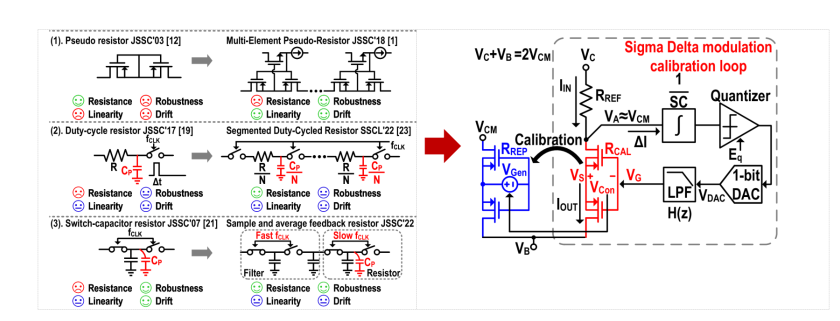
Researchers at Shanghai Jiao Tong University have developed an on-chip pseudo-resistor tunable from GΩ to TΩ, solving long-standing issues in precision, temperature drift, and process robustness. Fabricated in 180nm technology, it achieves a temperature drift of only 0.12%/°C from -40°C to 80°C and improves accuracy by over an order of magnitude, enabling progress in brain-computer interfaces and underwater acoustic detection.
A physics and astronomy team advanced the study of rhombohedral six-layer graphene, realizing a switchable Chern insulator and observing multiple correlated quantum phases at integer and fractional fillings. This reveals complex coupling among charge, spin, valley, and topology, creating new opportunities for quantum computing and topological electronics.
Scientists at the Chinese Academy of Sciences tackled the solid electrolyte-lithium metal electrode interface challenge through anion regulation. An iodine-rich interface automatically fills gaps to maintain tight contact. Prototype batteries demonstrate stable performance over hundreds of cycles, supporting safer and more efficient power for electric vehicles and humanoid robots.
ICgoodFind : These advances in sensing, quantum control, and energy storage underscore China’s accelerating innovation and growing self-reliance in core technologies.







