


STM32H750VBT6: The High-Performance MCU That Redefines Embedded Design
Introduction
In the rapidly evolving world of embedded systems, selecting the right microcontroller (MCU) can make or break your project. Among the myriad of options available, the STM32H750VBT6 stands out as a true powerhouse—offering an exceptional balance of processing speed, memory flexibility, and peripheral richness. Whether you are developing advanced motor control, high-end audio processing, or AI edge inference, this chip from STMicroelectronics delivers performance that rivals many application processors. In this article, we will dive deep into the architecture, key features, real-world applications, and design considerations of the STM32H750VBT6, and explain why it has become a favorite among professional engineers. For sourcing this component at competitive prices and with guaranteed authenticity, ICGOODFIND is your trusted global distributor.
Body
Part 1: Core Architecture and Processing Power
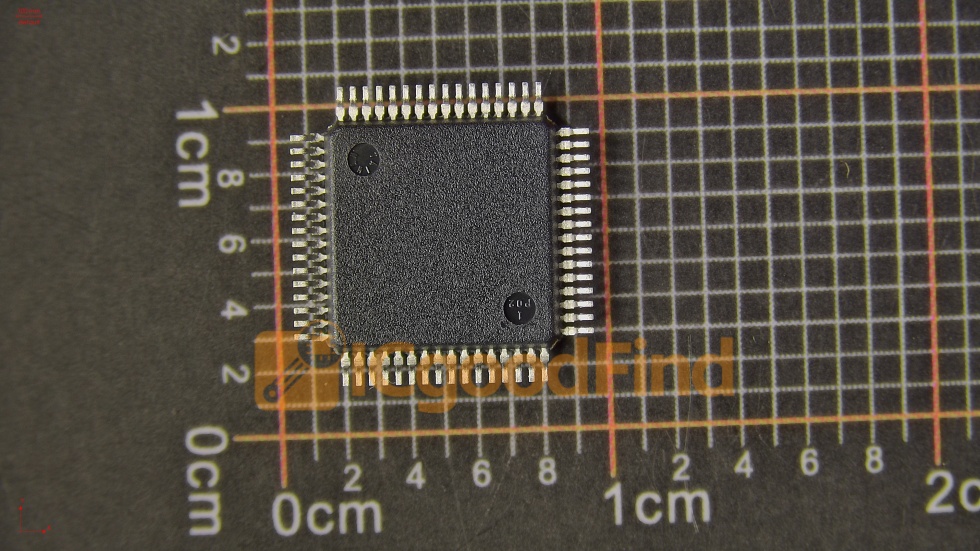
The STM32H750VBT6 is built on the ARM Cortex-M7 core, running at a blistering 480 MHz (with the ability to overclock to 550 MHz in many cases). This is not just a number—the Cortex-M7 features a dual-issue superscalar pipeline and a single-precision FPU (Floating Point Unit), which makes it exceptionally efficient for complex mathematical operations. Unlike many MCUs that rely on external memory for large code, the H750 integrates a 128 KB flash and 1 MB of RAM (including TCM, AXI SRAM, and regular SRAM).
But here is the clever part: the H750 is part of ST’s “value line” of the H7 series. The flash is intentionally small (128 KB), but the chip supports external memory interfaces such as FMC (Flexible Memory Controller) for NOR/NAND flash and SDRAM, as well as QSPI for memory-mapped external flash. This means you can execute code directly from external flash (XIP) at near-zero wait states, effectively giving you unlimited code space. For example, you can run a full FreeRTOS + LVGL GUI or a TensorFlow Lite Micro inference engine by simply mapping external flash.
Key architectural highlights: - L1 Cache (I-Cache and D-Cache) of 16 KB each, reducing latency when accessing external memory. - Hardware Accelerators for cryptography (AES, DES, SHA) and a true random number generator (TRNG). - Dual-bank flash support for safe over-the-air (OTA) updates, even though the internal flash is small—you can use external flash for the main app and internal for the bootloader.
From a performance benchmark perspective, the STM32H750VBT6 scores over 2400 CoreMark points, which is roughly 3-4 times faster than a typical Cortex-M4 at 180 MHz. This headroom allows you to run complex algorithms like FFT (Fast Fourier Transform) for power quality analysis or real-time audio effects without breaking a sweat.
Part 2: Rich Peripherals and Connectivity
What truly sets the STM32H750VBT6 apart is its comprehensive set of peripherals, which are usually found on much larger and more expensive SoCs. Let’s break them down:
1. Advanced Analog & Timers: - 2x 16-bit Advanced Motor-Control Timers (with dead-time generation and fault inputs), ideal for PMSM/BLDC motor control using FOC (Field-Oriented Control). - 3x 16-bit and 2x 32-bit general-purpose timers, plus 2x low-power timers. - 3x 12-bit ADCs with up to 5 MSPS (Mega Samples Per Second), supporting oversampling and hardware averaging. This is critical for high-speed data acquisition in industrial sensors. - 2x 12-bit DACs with built-in waveform generator.
2. Communication Interfaces: - 6x UART/USART (with ISO7816, LIN, IrDA, and SmartCard support). - 4x SPI (up to 100 MHz), 4x I2C (with FM+ mode at 1 MHz), and 2x FDCAN (CAN FD) for automotive and industrial networking. - 2x USB 2.0 OTG (one full-speed, one high-speed with on-chip PHY). The high-speed USB is a game-changer for applications like data loggers or CNC controllers that need fast PC communication. - Ethernet MAC (10⁄100 Mbps) with dedicated DMA and IEEE 1588 precision time protocol (PTP) support. This makes the H750 perfect for industrial IoT gateways. - 8x digital camera interface (DCMI) and 2x SAI (Serial Audio Interface) for I2S/TDM audio, enabling voice recognition or audio streaming applications.
3. Graphics and Display: Although the H750 does not have a built-in TFT LCD controller (unlike its bigger brother H743), you can easily drive displays via SPI, parallel FMC, or even RGB panels using GPIO bit-banging with the help of the DMA and the high clock speed. Many open-source projects use the H750 with LVGL to create stunning UIs on small to medium-sized screens.
4. Power Efficiency: Despite the raw power, the H750 offers multiple low-power modes (Sleep, Stop, Standby) with a typical current draw of less than 10 µA in Standby mode (with RTC on). This allows battery-powered devices to remain dormant for months while still waking up instantly to process data.
A practical note on sourcing: Because of its popularity, the STM32H750VBT6 is often subject to supply chain fluctuations. To avoid counterfeit or out-of-spec chips, always purchase from reputable distributors. ICGOODFIND offers a rigorous verification process, real-time inventory, and global shipping, ensuring you get genuine ST parts with full traceability.
Part 3: Real-World Applications and Design Tips
The STM32H750VBT6 is not just a theoretical marvel—it is already deployed in thousands of commercial products. Here are three typical use cases that highlight its versatility:
Application 1: High-End Drone Flight Controller Drones require fast sensor fusion (gyro + accelerometer + magnetometer) at 8-10 kHz, plus real-time PID control loops. The H750’s 480 MHz clock and dedicated hardware FPU allow you to run a Kalman filter on all axes simultaneously while still having CPU headroom for GPS, telemetry, and obstacle avoidance algorithms. The 2x FDCAN ports let you connect to external ESCs (Electronic Speed Controllers) using the CAN protocol, reducing wiring complexity.
Application 2: Industrial Predictive Maintenance System Using the 3x ADCs with simultaneous sampling, you can capture vibration signatures from three accelerometers at 100 kSPS each. The H750 can perform a 1024-point FFT in under 50 microseconds, enabling real-time spectral analysis. With the Ethernet MAC, the device can stream processed health metrics to a PLC or cloud dashboard via MQTT. The crypto accelerator ensures secure communication (TLS/DTLS) without slowing down the main loop.
Application 3: Portable Medical Device (e.g., Pulse Oximeter) The H750’s low-power modes and high-speed processing make it ideal for battery-operated medical monitors. You can use the SPI interface to read an AFE4404 analog front-end for SpO2 and heart rate, run a digital filter for motion artifact removal, and display the waveform on a small TFT via SPI. The TRNG can be used for patient data encryption, ensuring HIPAA compliance.
Design Tips for Engineers: - Power Supply Decoupling: Always place a 100 nF capacitor close to each VDD pin and a 4.7 µF bulk capacitor near the main supply. The H750 can draw over 300 mA during flash programming or heavy computation. - Boot Configuration: The H750 has multiple boot modes (flash, RAM, system memory). For production, set the BOOT0 pin to low (flash boot) and use the dual-bank feature to implement a robust OTA update mechanism. - Thermal Management: At 480 MHz, the chip can dissipate around 500 mW. For enclosed designs, consider adding a thermal pad or a small heatsink, especially if you are also driving external SDRAM at high speed. - Debugging: Use the SWD (Serial Wire Debug) interface with a 10-pin connector. The H750 supports ETM (Embedded Trace Macrocell) for real-time instruction tracing, which is invaluable for optimizing time-critical loops.
Why ICGOODFIND? When you are ready to move from prototype to production, the last thing you want is a supply chain headache. ICGOODFIND specializes in hard-to-find and high-demand MCUs like the STM32H750VBT6. They offer competitive pricing, fast same-day dispatch, and a 365-day warranty on all components. Their team also provides technical datasheets and reference designs to accelerate your development cycle.
Conclusion
The STM32H750VBT6 is a remarkable engineering achievement. It brings application-class performance to the microcontroller world, allowing developers to consolidate multiple functions into a single chip, reduce BOM costs, and shorten time-to-market. Its combination of a 480 MHz Cortex-M7 core, extensive connectivity (Ethernet, USB HS, CAN FD), and flexible external memory support makes it the go-to choice for advanced embedded projects—from robotics and industrial automation to smart medical devices and high-fidelity audio.
However, with great power comes great responsibility. You must carefully design your power supply, clock tree, and PCB layout to fully unlock its potential. And when it comes to procurement, never compromise on quality. ICGOODFIND ensures that your supply chain remains robust, authentic, and cost-effective, so you can focus on what you do best: innovating.
If you are ready to elevate your next design, give the STM32H750VBT6 a serious look. It is not just an MCU; it is a complete system-on-chip that will serve you for years to come.







