From server-grade core computing support to embedded low-power applications, and from industrial control scenarios to mobile terminals, flagship products from five major brands—Zhaoxin, Hygon, Phytium, Loongson, and Huawei—have built a full-scenario localized computing ecosystem. This ecosystem injects robust momentum into critical infrastructure and the digital transformation of various industries.
Zhaoxin's New-Gen Server Processor: KaiSheng KH-50000 Series Leveraging Chiplet architecture for performance leaps, the KaiSheng KH-50000 series integrates up to 96 high-performance computing cores per chip, paired with 384MB L3 cache for solid computing fundamentals. Fully upgraded I/O interfaces support up to 12-channel DDR5 ECC memory, 128-channel PCIe 5.0/ZPI/CXL, and 16-channel PCIe 4.0/SATA/USB, boosting data throughput significantly. In terms of expansion and interconnection, it supports 2-way and 4-way systems, enabling a single server to have up to 384 computing cores for leapfrog improvements in computing density. The new ZPI 5.0 interconnection technology further enhances data bandwidth, reduces latency and power consumption, providing reliable guarantees for high-intensity applications such as AI, cloud computing, and big data. With these advantages, the KH-50000 can build various computing bases (high-performance workstations, general-purpose servers, high-density AI servers, etc.), meeting diverse needs like edge computing, AI training/inference, and high-density storage. Key specs: Base frequency 2.2/2.6GHz, max turbo frequency 3.0GHz; compatible with x86 32/64-bit instructions and SM2/SM3/SM4 acceleration instructions; supports processor and I/O virtualization, balancing adaptability and security.
Hygon 5000 Series Processor Focused on the mid-range mainstream market, it integrates 8-16 cores, supports 64 PCIe lanes and 4 DDR4 memory channels, with a single CPU supporting up to 1TB memory. Precisely adapted to cloud computing, edge computing, and distributed storage scenarios, it meets the computing needs of enterprises in internet, finance, telecommunications, transportation, energy, and other industries, serving as a reliable computing backbone for industrial digital transformation.
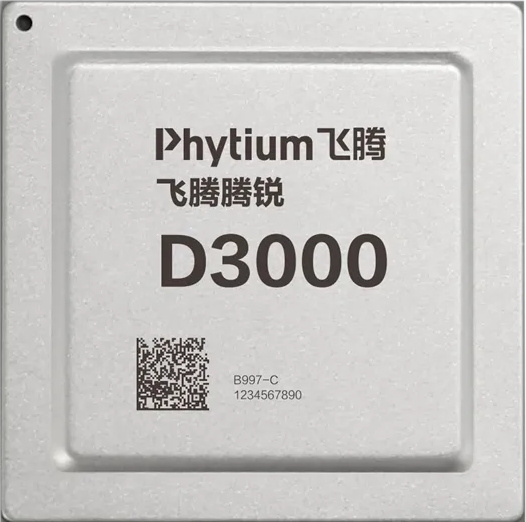
Phytium High-End Embedded CPU: Tenglong E2000 Series Targeting segmented scenarios, it includes three sub-series (E2000Q, E2000D, E2000S) with Phytium's self-developed high-efficiency, low-power cores. The E2000Q integrates 2 FTC664 + 2 FTC310 cores, E2000D has 2 FTC310 cores, and E2000S has 1 FTC310 core. Fully compatible with 64-bit ARMv8 instruction set (supporting ARM64/ARM32 modes), it features single/double-precision floating-point operations and ASIMD processing, along with hardware virtualization and commercial/industrial grade options. Focused on cloud terminals, industrial tablets, power, rail transit, server BMC, network devices, and intelligent control, it meets complex embedded application needs with high security, reliability, and low power consumption.
Loongson 2K3000 (3B6000M) Processor Preliminary function and performance tests meet expectations. It shares the same silicon die as Loongson 3B6000M (different packaging), targeting industrial control and mobile terminal markets respectively. Integrating 8 LA364E cores, it achieves 30 points in SPEC CPU2006 Base single-core fixed-point tests at 2.5GHz, delivering excellent computing performance. A core highlight is the 2nd-gen self-developed GPGPU core LG200, doubling graphics performance compared to the 1st-gen LG100. It supports general computing acceleration and AI acceleration, with 256GFLOPS single-precision floating-point peak performance and 8TOPS 8-bit fixed-point peak performance; OpenCL computing framework and related AI acceleration software have completed preliminary tests. Additionally, it has built-in independent hardware encoding/decoding modules (supporting mainstream video formats, 4K@60fps processing, and eDP/DP/HDMI triple display interfaces), security trusted modules, and reconfigurable cryptographic modules for data security. Rich I/O expansion interfaces (PCIe3.0, USB3.0/2.0, SATA3.0, etc.) adapt to diverse needs; dozens of industrial control and information terminal enterprises have started product design with this chip.
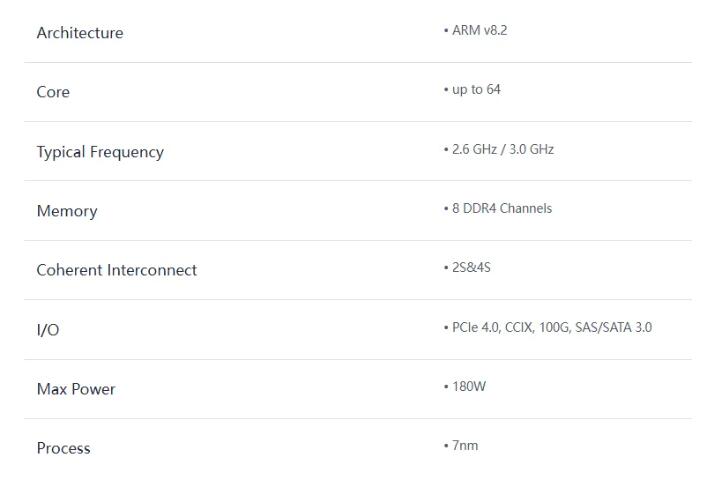
Huawei ARM-based Processor: Kunpeng 920 Ranked among industry leaders with advanced process and architecture design, it adopts 7nm manufacturing process and is independently designed based on ARM architecture authorization. Through microarchitecture innovations (optimized branch prediction, increased computing units, improved memory subsystem), it achieves significant performance breakthroughs: SPECint Benchmark score exceeds 930 at typical frequency (25% higher than industry benchmarks), with 30% better energy efficiency than industry benchmarks, balancing low power consumption and high performance. With a max frequency of 2.6GHz and 64 cores per chip, it is the industry's first general-purpose processor with built-in 100GE direct network capability, providing efficient computing support for data centers.
ICgoodFind : Domestic CPUs have formed a full-scenario product matrix with continuously improving performance and adaptability. The localization replacement process is accelerating, laying a solid foundation for the independent development of the semiconductor industry chain.